Community Search of Tom and Jules
Bird BoxTom and Jules’s community search is a supply-and-animal-finding expedition that exposes the human cost hidden inside abandoned homes. In the course of seeking dogs, the men discover a boy’s carefully arranged family and an emaciated husky, then find a second husky in a garage. Their finds offer the household potential companions and working animals, but each animal has to be approached as an independent, unpredictable presence rather than treated as a simple resource.
Setting and Survival Preparations
The search takes place in a world where ordinary movement has become a coordinated risk. At the house, the windows are covered with black blankets, and the group keeps food in reserve: Felix reports that a supply run made before the first incident was reported in the Upper Peninsula left them with about three months of canned goods. By the time Malorie arrives, Don notes, the estimate has already fallen, an everyday reminder that another person changes the household’s calculations.
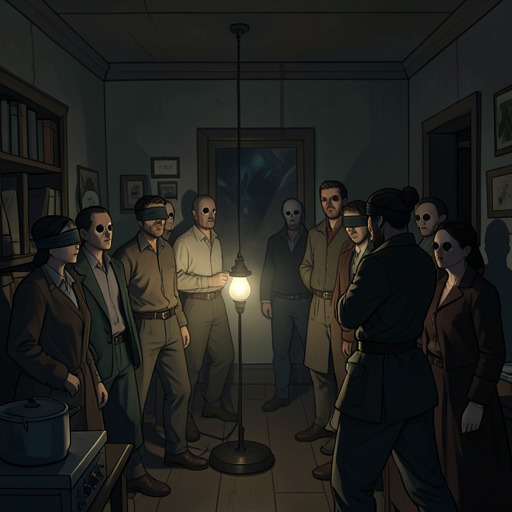
The community’s precautions extend beyond its covered windows. Tom proposes helmets to protect their blindfolds, butcher knives for emergencies, and dogs that might lead the searchers; if an animal became dangerous, he says, they would have to release its leash. His proposed expedition depends on a fragile balance between using animals for their abilities and recognizing that they, too, may be affected by the catastrophe. The group’s broader rules are equally practical: the attic door has a strong bolt, while the old cellar door is delicate, making the attic the safer place to secure themselves if a creature enters the house.
Felix’s trip to the well provides a close parallel to the searchers’ later movement through the neighborhood. Blindfolded, he carries the old wooden bucket, whose iron handle and shape make it the one that fits the well’s hooks. A rope tied around his waist runs back to a steel stake beyond the rear door; pieces of old picture frames mark the path so he can stay on course. Cheryl waits inside the closed back door as a safety net, while Jules waits near the stake. These procedures show the household turning familiarity with its immediate surroundings into a form of protection, without removing the chance that something will go wrong.
The House and the First Dog
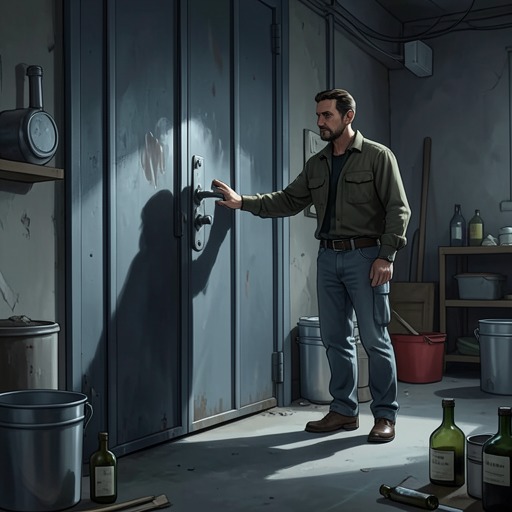
During the community’s search, Jules points Tom toward a discovery in a house. At the basement stairs, the two men find the parents lying on their backs, dressed as if for church. A piece of notebook paper on the mother’s chest bears the words “ReStiNg pEaCe.” Jules explains that there is no food in the house and wonders how the boy survived. Tom identifies the boy as the one who arranged his parents and wrote the message. The scene makes the abandoned home more than an empty place to search: it contains evidence of a child’s attempt to give his parents’ deaths a name and a sense of order.
Beyond the parents, Jules finds a husky hunched among fur coats on a dress rack. The dog is close to emaciated, and Tom imagines that it may have been feeding on the dead. Jules offers meat from his duffel bag, tearing off a piece and tossing it down the stairs. The husky first approaches slowly, then eats. Jules continues feeding it and speaking encouragingly, using food and patience to begin a bond rather than assuming the animal will trust them immediately.
The men spend the rest of the day in the house. While Jules works with the dog, Tom searches the places Jules has already examined. He finds neither a phone book nor food, and little else that their own household needs. The expedition has yielded a dog, but not the provisions or information that might have made the outing more straightforward. Jules, who knows dogs better than Tom, judges that they cannot leave yet: the husky remains erratic and does not trust him. Tom, meanwhile, is conscious of the twelve hours he gave the people at home for their return. The need to earn the dog’s trust collides with the deadline of the group’s expected reunion.
A Second Discovery and the Return
On the way home, Jules hears the first husky making a commotion near a freestanding garage. He believes something living may be inside. Tom is still frightened by what they have found in the house and by a tent in the street that seems inexplicable to him; he would rather continue home. Jules wants to investigate the dog’s interest. When he reaches inside, he identifies another husky by touching its face. The second dog is not a supply they can simply collect: the discovery requires attention and a decision about whether to bring it back.
Jules leashes the second husky, which proves less difficult than the first. Before leaving the garage, he asks Tom whether he is bringing the birds. Tom confirms that he has an idea, though the exchange does not specify what he intends to do with them. They retrieve the first husky and set off, Jules walking with the second dog and Tom with the first. Their return proceeds slowly across lawns and driveways until they reach the marker they had set the day before. The marker gives their movement a known endpoint in a neighborhood that otherwise offers few assurances.
At the front porch, before knocking, Tom hears the housemates arguing inside and thinks he hears a sound from the street behind him. The search therefore ends not with uncomplicated relief but with a new uncertainty at the threshold. The men have found two dogs and brought them toward the community, yet the noises around the return leave the immediate safety of home unresolved.
Animals, Care, and the Limits of Control
The search establishes different roles for animals without reducing them to one function. Dogs may guide blindfolded people, as Tom’s plan anticipates, and their arrival can create the possibility of companionship. But that possibility depends on the animals’ behavior and their own histories: the first husky is wary, and earning its trust takes the rest of the day. The second is easier to leash, but it too must be approached through attention to what it does and what it will tolerate.
The household’s existing relationship with Victor gives this care a domestic precedent. When Malorie first meets the border collie, he approaches her feet and waits for her to pet him; Jules explains that he got Victor as a puppy and that the dog is six years old. Malorie thinks Shannon would have liked him. This small meeting links animal companionship to memory and grief, while the search extends that bond into a harder setting where feeding and patient contact are matters of survival.
The later fate of Victor reveals the limit of the community’s hope that animals can remain safe companions. As the catastrophe’s effects reach him, his growl becomes unfamiliar to Malorie, and the wooden post holding him splinters as he moves violently. Elsewhere, Malorie feels a tiny broken bird in the rain and realizes that birds are killing one another above her. These later episodes complicate the search’s promise: dogs and birds can support human survival, but they are also vulnerable to the same destabilizing world. The search matters because it begins as a practical effort to find help and ends, in the larger pattern of the story, as part of a more difficult lesson about living with animals whose needs and dangers cannot be controlled by human plans.